
The Backstory
Artificial intelligence is shaping up to be the most consequential frontier technology of this century. And it seemed to come out of nowhere. In fact, the first natural language processing computer program, called ELIZA, was developed nearly 60 years ago. (1) Since then, AI has gone through many boom and bust cycles in order to emerge stronger than ever at the end of 2022. It’s hard to overstate the multitude of factors that had to align for ChatGPT to emerge so explosively on the world scene in November 2022. Since then ChatGPT, a generative AI chatbot, alongside a growing wave of other generative models, has been reshaping not only the tech industry in Silicon Valley and beyond, but also the way people interact with technology. At the same time, artificial intelligence is influencing a wide range of industries – from healthcare, customer experience and banking to defense, cybersecurity and logistics.
Why This Matters
All of this explosive growth will inevitably come at a cost. It is no taboo that AI has already started restructuring the labor market, displacing not only less skilled workers but also impacting the creative industries, previously thought to be a space exclusively dominated by humans. As we have experienced before with technologies born in Silicon Valley – things move fast and, inevitably, there is collateral damage. Recently, the first reports and projections about the impact of artificial intelligence on natural resources started to emerge. There is no cause for panic yet, but it is wise to start putting pieces of the puzzle together as early as possible so we, collectively as a society, can assess the risks and decide what level of risk we’re willing to accept.
What Is AI’s Demand for Natural Resources?
In this post, I will examine the demand of AI systems for two critical resources – energy and water – which are essential not only for our survival, but are also key for a thriving and equitable economy. I’ll begin by looking at the trajectory of AI systems’ growth. After that, I’ll analyze the water consumption of AI systems, as well as overall trends in water use and availability. Finally, I’ll assess the energy demands of AI systems and the distribution of data centers across the United States. I will often use ChatGPT as a proxy for AI systems. There are simply too many companies releasing new products daily. My objective is not to provide an exhaustive analysis of all those products’ impact on natural resources but rather to paint a broad picture and, hopefully, detect trends that can inform future decision making, on personal and societal level.
Datasets, Variables, and Limitations
My analysis is based on several datasets. I will use a commercial dataset by Aterio – “US Data Center Locations and Power Demand”. The following variables from this dataset will be included – Provider Name, Data Center Stage, State Code, Total Power (MW). Another dataset I will be working with is “State Total Energy Rankings” by the U.S. Energy Information Administration (EIA). The variables I will be analyzing from this dataset are – State, Commercial Energy Consumption (Trillion Btu). I will also use two datasets from Our World In Data. The first one is “Renewable Freshwater Resources Per Capita.” The variables in this dataset are – Entity, Year, Renewable internal freshwater resources per capita (cubic meters). The second one is “Freshwater Withdrawals Per Capita,” where I’m working with the variables Entity, Year, Annual Freshwater Withdrawals Total (billion cubic meters).
Data for my ChatGPT water footprint analysis is taken from the research paper “Making AI Less “Thirsty”: Uncovering and Addressing the Secret Water Footprint of AI Models” by Shaolei Ren et.al. The variables used are Location, Water for Training (Million Liters), Water for Each Request (milliliters), Number of Requests for 500ml Water. I will also visualize projections about US data center energy demand growth based on findings in the report “Powering the Future of U.S. Data Centers” by Accenture Research. The variables that I will use are Year, Scenario, Minimum Growth Percentage, Maximum Growth Percentage. Data for ChatGPT user growth is based on statistics published by intelliarts and Statista. Variables used are Date and Weekly Active Users (in millions).
There are also certain limitations in the data that I would like to point out. As technology companies tend to keep their energy consumption under wraps, there is no exact data on how much energy certain AI models require. Similarly, data centers are rather secretive about their energy use. As a result, there is no explicit data on energy consumption of AI models. I will, therefore, use the number and concentration of data centers as a proxy for AI’s energy use. This is undoubtedly a broad and imperfect analysis. However, getting a sense of the broad picture gives us an understanding of the dynamics and trends.
1. Use of AI
The adoption of generative AI chatbots like ChatGPT has been nothing short of astonishing. ChatGPT is based on Large Language Models (LLMs) such as GPT-4o and, more recently, reasoning models such as o3 and o4-mini. Within five days of ChatGPT’s launch in November 2022, its user base grew to one million. This is faster than any other platform, except for Threads. (2) Considering the dizzying growth of adoption so far, it is safe to assume that this technology is not only here to stay but will also continue on an exponential growth trajectory.
2. AI Infrastructure
To understand what powers AI systems, it’s helpful to examine their underlying infrastructure. There are a few things that power the technology. Firstly, there are the critical minerals used for production of GPUs (graphics processing units). The use of critical minerals will not be a focus point in this blog post. Secondly, there are the data centers that house all the GPUs and where AI is trained. There are two main resources that data centers require lots of – water, for cooling the different systems, and energy, for powering them. In the following sections, we’ll go into more detail about water and energy consumption.
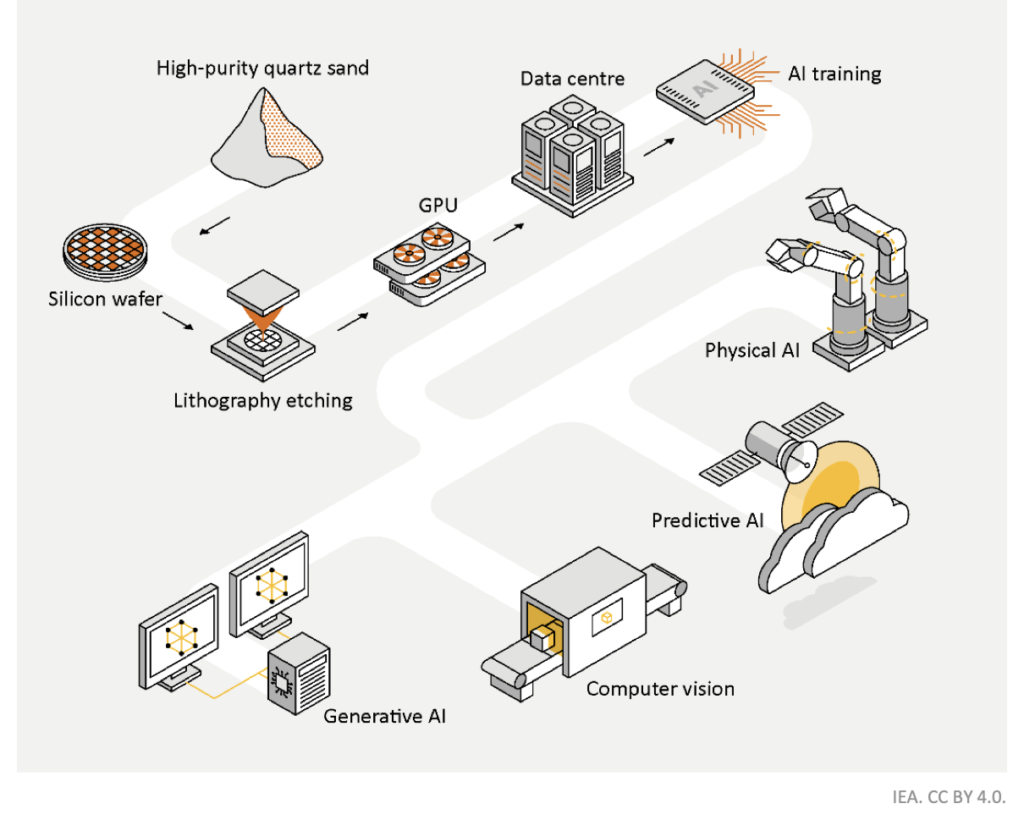
Image source: International Energy Agency
3. How Thirsty is AI?
The answer to this question largely depends on where the data center is located. Recently, a study compared water use for training and inference. (3) Inference is the process that an LLM uses to make a prediction, solve a task or draw a conclusion. (4)
We can see in the graph above that there are stark differences in the amount of water used to train AI models in different states. Washington state, for example, uses 6 times more water than Texas. The variation in amount of water used can be due to different factors, the most significant of which is the way energy for a data center is generated. Washington state uses hydroelectric, which needs large amounts of water to turn turbines. Natural gas and coal need larger amounts of water for cooling. Wind and solar use minimal water.
Training of AI models is an extremely water-intensive process. On the upside, models are mostly trained before their release hence this enormous water consumption doesn’t occur frequently. What does occur constantly, however, are requests, also known as inference, sent to ChatGPT.
We can see that in Washington state 10 GPT-3 requests equal a 500ml bottle of water. In Texas, one would need to make 66 requests for a bottle of water. The US average is 30 requests for a bottle of water. We can also see that both the amount of water needed to train and query Chat GPT vary immensely between states. Interestingly, one never knows where a query will be sent to for processing. A ChatGPT user based in New York state can have their request processed in a data center in Wyoming. One can only hope that their requests are directed to the most water-efficient data centers.
In the graph below, you can see that the states that are not water-efficient in term of training are also not efficient in terms of request processing. And conversely, states such as Texas, Georgia and Wyoming are more efficient in performing both tasks.
Please keep in mind this large efficiency divergence in water use. Later, we will look at the distribution of data centers in the United States and it will be interesting to see if they tend to be located in places with lower water needs. If this turns out for this to not be the case, and many data centers crop up in locations that are “thirstier,” this raises the question: why aren’t data center locations optimized around this vital criterion?
Putting Water In Context
It’s no surprise that freshwater is a rapidly depleting resource. Currently, AI data centers use massive amounts of water for cooling. (5) There is an effort, at least in principle, to make those cooling systems more efficient. Until then, they require substantial amounts of a limited resource.
Renewable internal freshwater resource flows represent the water generated within a country by renewable resources – specifically the flow of its rivers and the recharge of its groundwater from rainfall. The availability of renewable freshwater resources has been declining steadily since the 1960s. This trend is only expected to intensify due to climate change.
Next, let’s look at freshwater withdrawals. Annual freshwater withdrawals represent the total volume of water drawn each year—measured in cubic metres (m³)—excluding any evaporation losses from storage basins. They comprise the combined withdrawals for agricultural, industrial and municipal (domestic) uses, and, in places where desalination is a major source, also include water produced by desalination plants.
On a more positive note, we can see that total withdrawals of freshwater in the United States have remained relatively stable for the last thirty years.
4. Power Hungry AI
The other resource that AI needs a lot of is energy. According to a 2024 report by the Department of Energy (6), by 2028 electricity demand by data centers will constitute between 6.7% and 12.0% of total electricity demand in the United States. The forecast of the DOE is actually a base scenario. Other future models predict significantly higher energy use by data centers, especially the so called hyperscalers (7). A hyperscaler is a data center that offers virtually infinite compute, database, and storage capacity.
According to the most conservative predictions, energy demands by data centers will grow between 4 and 15 percent. In the baseline scenario, demand will grow between 13 and 16 percent. There are two forecasts for high growth – one representing a 13 to 27 percent increase and the other a 20 to 40 percent increase in demand for energy. (8) Needless to say, if this last scenario materializes, there will be many negative ramifications. However, the impact on U.S. households and small businesses will be especially detrimental as they might have to compete for access to electricity with large data centers. Pricing of electricity will also most certainly go up and become unaffordable for many retail consumers.
5. The Data Centers That Power AI’s Growth
As technology companies are very tight-lipped about their energy consumption, there is no exact data on how much energy certain AI models require. By the same token, data centers are also rather secretive about their energy use. Consequently, there is no available data on energy consumption of AI models. I will, therefore, use the number and concentration of data centers as a proxy for AI energy use. This is by all means a rather broad and imperfect analysis. Getting a sense of the broad picture, however, gives us a sense of the dynamics and trends. It also allows us to point our attention in the right direction. Over time, more scientists and regulatory bodies will likely begin conducting precise calculations and impose reporting requirements on the technology companies that own the AI models.
Now, let’s get into more granular details about the data centers that power AI’s explosive growth. One way or another, we have already heard that Virginia is the home to a large amount of data centers. Below, you can see the exact scale of this concentration. The five states hosting the largest number of data centers consume significantly more energy than the national average. A noteworthy mention is Texas, home to some 409 data centers, which consumes five times more than the average state. California consumes almost four times the national average. There are a few states, such as Oregon, Nevada and Iowa, that host many data centers but are below the national average. This can be attributed to the composition of their energy mix, which is heavily weighted toward renewables. (9)
Below you can see the power capacity of data centers across the United States. Power capacity is the amount of energy that a facility can produce. Not all data centers work at full capacity. Texas and Virginia alone hold more than 30 percent of the total US data center power capacity. Other honorable mentions are Georgia, Illinois and Arizona.
The trend of data center concentration will continue into the future – the top five states account for half of all newly announced and under construction facilities. Virginia is currently building 99 data centers and has announced the construction of another 332. Georgia and Texas have announced 205 and 170 new plants, respectively. Arizona has announced 98. A notable mention is Pennsylvania, with 109 announced data centers. This is 109 more than the state currently has.
This brings us back to the question raised earlier about water efficiency – given that some states are inherently “thirstier,” do those same states tend to be avoided as data center hosts. The graph below gives us a clear answer, and unfortunately this answer is a clear NO. Arizona is a place that gobbles up massive water supplies in order to train AI models. At the same time, it is one of the most arid places in all of the United States. All of this leaves us wondering – why is Arizona the fourth most preferred location for data centers and aren’t there any regulations in place to govern such fateful decisions?
Next, let’s zoom out and look at the forecast for new data center development at a high level. As of May 2025, there are as many newly announced and under construction facilities as there are already active ones. This is nothing short of a breakneck expansion, which highlights the urgency of this issue.
Conclusion
Despite all their limitations, the data analyzed above reinforce the same narrative – the use of AI models is on a path of exponential growth. This growth necessitates the use of two main resources – water and energy. While water consumption is at its highest during the training phase of AI models, the intensified daily use of AI, as evidenced by the explosive growth in ChatGPT’s user base, means that consistently higher quantities of water will be necessary to cool the data centers that service an ever-expanding number of queries. As evidenced by the future energy demand scenarios that were examined above, the U.S. energy sector will soon be under an incredible pressure to service this heightened demand, while also providing reliable and affordable energy to its residential consumers.
Given the massive scale of these trends and their far-reaching ramifications for individuals, society, and the economy as a whole, it is unreasonable to expect the onus of responsibility to fall on individual users of AI technologies. There needs to be a concerted effort on local, state and federal level to regulate this impending economic shift of unparalleled proportions. It would be unwise to just sit back and watch the changes unfold. At stake are the stability of electricity grids and the strain on already dwindling water reserves. That’s not to say individuals have no agency. There are small steps that we can take in order to mitigate the environmental impact of our AI technology use. We can be mindful of the types of queries that are simple enough to be performed by search engines instead of a reasoning model. We can demand adequate regulations—at both the state and federal levels—that ensure a sustainable future.
Unfortunately, just as I finished writing this post on May 22, 2025, the U.S. House of Representatives passed a bill that bans state AI regulations for ten years. (10) One can only imagine the chokehold that such a legislation will place on any effort to regulate AI technologies for the public interest.
Citations:
1) Simone Natale, Deceitful Media, Oxford University Press 2021, Chapter 3. The ELIZA Effect, p. 50
2) https://intelliarts.com/blog/chatgpt-statistics/
3) Making AI Less “Thirsty”: Uncovering and Addressing the Secret Water Footprint of AI Models. Pengfei Li, Jianyi Yang, Mohammad A. Islam, Shaolei Ren
4) https://research.ibm.com/blog/AI-inference-explained , https://www.cloudflare.com/learning/ai/inference-vs-training/
5) https://itcc.ieee.org/blog/the-hidden-cost-of-ai-unpacking-its-energy-and-water-footprint/
10) https://tech.yahoo.com/articles/house-passes-budget-bill-inexplicably-184936484.html

This entry is licensed under a Creative Commons Attribution-NonCommercial-ShareAlike 4.0 International license.

